Marc Sadler and CIAM: The Nomadic Soul of Cold
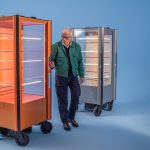
The relationship between a designer and a company is not a linear journey, but a true convergence of needs and expertise.
“Design should be a response for the company.
The capacity to bring it to life, a necessity for the designer.”
Marc Sadler
In the case of the collaboration between Marc Sadler and CIAM, it all began with an observation made during a factory visit: refrigeration excellence was still “imprisoned” by fixed architecture and a power cable.
Marc Sadler identified a void: applying “nomadism” to professional refrigeration.
“Design should be a driving force for both designers and companies, inspiring a willingness to venture into a world still to be discovered and invented. By bringing refrigeration into contexts that previously didn’t exist, we created something entirely different.”
EMBRACING TECHNOLOGICAL RISK
In this process, Sadler acted as the provocateur of a need. CIAM, in turn, provided artisanal rigor and industrial capacity, embracing the technological risk required to transform a vision into an industrial standard.
The challenge lay in giving stability to a high-performance professional system by untethering it from the electrical grid.
“The greatest challenge we faced was developing a system with enough operational autonomy to run this device through a standard usage cycle, for several hours.”
THE PROTOTYPE: WHERE TECHNOLOGY BECOMES INVISIBLE
The transition from idea to prototype was fueled by a continuous technical dialogue aimed at making the technology disappear, leaving the stage entirely to the displayed product.
A concrete example is the development of the cantilevered glass shelves, featuring integrated LED lighting.
Externally, the structure responds to the genuine need for physical mobility: heavy-duty handles integrated into the outer chassis and wheels designed to handle even uneven outdoor surfaces.
Then came the external protective and handling shell, engineered to perform flawlessly in any situation while maintaining a timeless design.
“Essentially a tank, but with a design language that echoes Dieter Rams and Bauhaus minimalism.”
For CIAM and Sadler, this pioneering act manifested in the ability to envision entirely new design scenarios. For FreeGo°, for instance, it meant reimagining cocktail parties in art galleries or events in remote outdoor settings.
The final result is not a static object, but a nomadic icon that redefines freedom in space. Instead of the project adapting to technological constraints, technology empowers design to venture into unexplored territories.
“Once on the market, FreeGo° will generate use cases we haven’t even imagined yet; it will become a solution generator itself. It is an example of how innovation is not a closed technology, but an open system.”