CIAM and Cantina Roccafiore: a partnership that Embodies Genius Loci and Made in Italy.
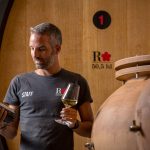
We met with Luca Baccarelli from Cantina Roccafiore in Todi and explored together the fascinating worlds of wine and Champagne.
A journey that, starting from the winery’s early days, takes us through international territories and new projects—such as the one behind its partnership with CIAM. Two Umbrian companies united by values that symbolize a contemporary Made in Italy, coming together in Milan to create an exclusive tasting experience.
In the rich and diverse landscape of Italian wine, what makes Cantina Roccafiore stand out?
Cantina Roccafiore has been around for 21 years and, from the very beginning, has been driven by a vision strongly oriented toward the future. Coming from outside the wine world, we sought to carve out a personal path free from the constraints of tradition. This took shape in the Todi DOC area, which itself lacked a strong winemaking history—an element that allowed us to interpret the territory freely, embracing the famous Genius Loci, which for us is the essential foundation for producing a great wine.
We created a new perspective and narrative, breaking away from old winemaking patterns. Despite starting out during a time of massive imports and plantings of foreign varieties in Italy, today we find ourselves very much in tune with the present.
What connects Cantina Roccafiore and CIAM?
There is certainly a shared bond with our territory, as well as a common drive to look ahead, explore new scenarios, and experiment with new possibilities. It was during our latest project that the evening at CIAM’s Milan showroom came to life.
The event aimed to present Cantina Roccafiore’s new side project: “Les Bulles”, an initiative focused on importing and distributing small-scale Champagne producers. This marks a shift from the local/national dimension to France, discovering a new generation of talents redefining Champagne with an artisanal approach, breaking away from the neo-classical models of big brands.
This new piece of the “Roccafiore” ecosystem was showcased during the tasting event “Et Voilà” in Milan, with CIAM’s elegant showroom on Via Pastrengo providing the perfect setting to introduce this new distribution reality and welcome an exclusive audience.
Wine and refrigeration design: what does this connection represent?
First and foremost, proper preservation: if wine is not stored and served at the right temperature, both its intrinsic value and the tasting experience suffer. A very current topic in this field concerns the correct temperature for red wines, which are increasingly served chilled rather than at room temperature.
In the U.S., for example, wine lists often include a category called “chillable red wines,” alongside the classic whites, reds, and sparkling wines. Today, having a refrigerated cellar dedicated to red wines—ensuring proper temperature and humidity levels—has become essential for delivering high-quality service and guaranteeing maximum enjoyment during tasting.
What role do aesthetics and design play in the contemporary wine world?
Despite their seemingly different realms – design creates solid forms, while wine gives life to liquid forms – I believe aesthetics is the true point of connection between these two worlds. Two different aesthetics, of course, that tell different stories: in the case of CIAM and its refrigeration strongly oriented toward design, it appeals primarily to the eyes, whereas in the case of wine, it is expressed through taste.
There is also an aesthetic linked to presentation: a wine is chosen by its label, but its positioning within a venue also carries great value. I am convinced that if, in high-end restaurants, wines were always displayed in design showcases rather than in standard cellars, it would strengthen the consumer’s perception of the product’s premium positioning, as well as that of the venue itself.
This is a crucial aspect, for example, when it comes to Champagne, whose display, if done properly, can spark curiosity in the consumer and generate interest that favors both the offering and the sale.
What can Italian wine convey to the world today?
I believe it still serves as an ambassador of Made in Italy, expressed through craftsmanship and telling a story of history, tradition, and culture. When we think of foreign markets, we often forget that, especially where there is no local production, wine still represents an object shrouded in mystery.
The vines, the practice of pruning, the harvest, and the very process of winemaking tell traditions and knowledge that are attractive and fascinating—not to mention the idea of experiencing the tasting of an Italian wine, an expression of great history and quality.
Therefore, I believe wine is increasingly perceived worldwide not only as an element of the table but as an expression of a true lifestyle that represents us.